Day trading binary options is intraday speculation on very short term price moves with a fixed payoff and a fixed loss. You are betting that an underlying asset will be above or below a level at a set expiry time, often minutes away. If your call is correct, you receive a pre defined payout. If you are wrong, you lose the stake.
For traders coming from spot FX, futures or equity day trading, binaries feel familiar on the surface. There are charts, levels, sessions and news events. Underneath, the product behaves much closer to a casino bet than a classic derivative. Regulators in many regions have said exactly that, and have either restricted or banned retail binaries after data showed most clients lost money over time.
This does not mean no one trades them, or that no edge is possible. It does mean the bar for risk control, product knowledge and discipline has to be high if you want any chance of staying solvent.
This article will focus on day trading binary options. If you want to learn more about day trading in general, then I recommend you visit DayTrading.com, one of the world’s best websites about day trading.
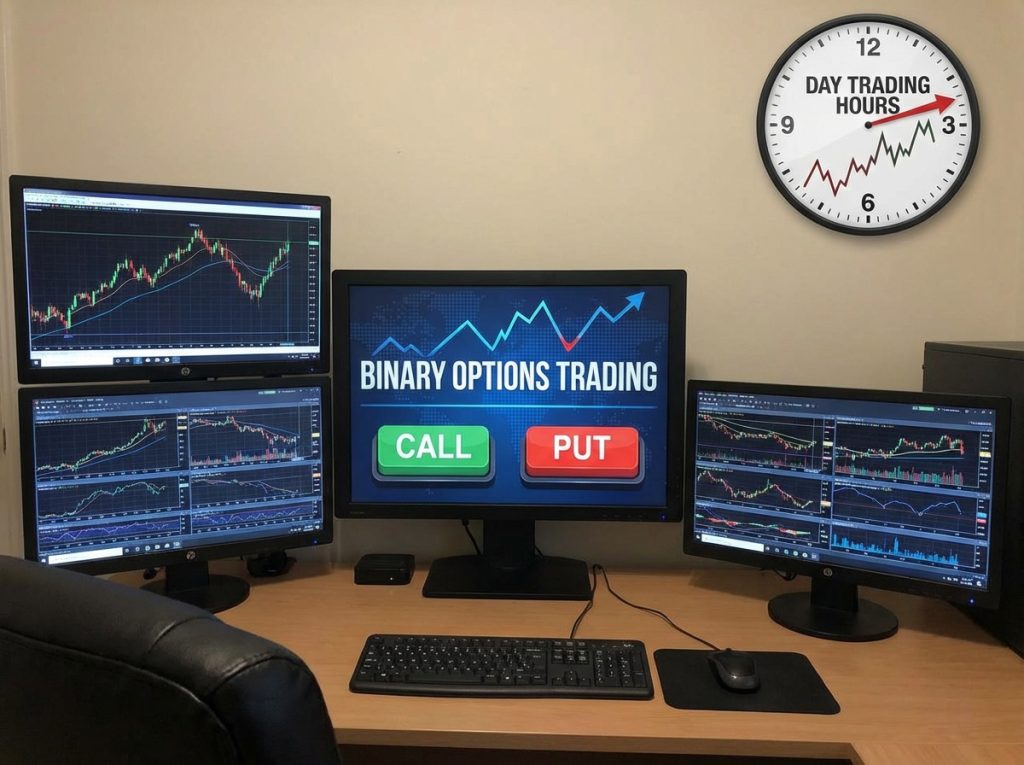
What binary options are, and how they compare to other intraday products
Basic structure of a binary contract
A typical cash settled binary option lets you take a yes or no view on a market. A simple “above” structure on EURUSD at 1.0900 with a five minute expiry might pay out 80 dollars on a 100 dollar stake if the market finishes above 1.0900 at expiry. If it does not, you lose the 100 dollars.
Everything is condensed into three variables. You choose the underlying (FX pair, stock index, share, crypto), you choose a strike or level, and you choose an expiry time. Payouts and quotes are set by the platform. The contract either settles at the fixed payout or at zero. There is no partial loss and no trailing stop. If your trade spends four minutes in profit but expires one tick out of the money, you lose the lot.
Many platforms express binaries in percentage payout. A 70 percent payout on a 100 dollar stake means you win 70 dollars if correct and lose 100 dollars if wrong. House margins are embedded in that payout. In an fair coin toss you would expect close to 100 percent payout pre fees. Binary platforms often pay 60 to 90 percent on what is close to a 50 or 60 percent event.
How binaries differ from spot FX, CFDs and futures
With spot FX, CFDs or futures you have floating profit or loss that moves with the market. You can manage a position after entry. That includes scaling in or out, moving stops or closing early. Your profit distribution has a wide range, and you can design trades so winners are larger than losers.
Binary options lock in the risk and reward at entry. There is no change in payoff if price blasts through your level, unless the platform offers a secondary market to close early, which is often at a disadvantageous price. The payoff profile is symmetric in size but asymmetric in expectancy because of the payout ratio. You can think of it as paying more for a lottery ticket than the expected value of the ticket.
This structure magnifies the importance of entry quality and trade selection. A small edge in win rate is not enough if payoff ratios are poor. At the same time, the simplicity appeals to some day traders who prefer a fixed stake, fixed outcome product instead of managing stops and take profit orders in fast markets.
Payoff mechanics, probabilities and edge
Fixed payout, strike, expiry
Every binary option quote encodes an implied probability that the event will occur. If the platform offers an 80 percent payout for a simple up or down contract that loses the full stake when wrong, the break even win rate is not 50 percent. You need to win often enough that the average profit per trade is positive.
If you stake 100 dollars per trade at an 80 percent payout, your average result per trade is:
Average result = Win rate × 80 dollars − (1 − Win rate) × 100 dollars
To break even, this is zero. Solving for the win rate gives a required win rate of about 55.6 percent. In practice, once you add slippage or any platform fees, the bar creeps higher.
You can also flip the logic. Suppose your trading method wins 60 percent of the time on a fair underlying with no house edge. The fair payout there would be roughly 66.7 dollars on a 100 dollar risk. If the platform pays much lower than that, your method may be profitable in theory on spot, but negative expectancy on the binary product.
Implied break even and house edge
Regulators and independent reviews have repeatedly found that retail traders lose money on binaries over time. European and Australian regulators cited loss rates above 70 or 80 percent among clients.
The reason is not just poor trading skill. The math is stacked against you. If you face a 55 to 60 percent required win rate just to stand still, then any slippage, poor entries, weak discipline or emotional decisions push you into loss territory fast. Many platforms set payout ratios to embed an edge similar to a casino game, while marketing binaries as a trading product.
For day traders looking for edge, this means you must treat payout tables as your equivalent of a spread and commission schedule. Two platforms offering the same underlying and expiry, but different payouts, are completely different businesses. If you ignore that and only think in terms of charts, you are missing the core of how you get paid or not paid.
Regulation, product bans and broker risk
Where retail binary options are banned or restricted
After years of complaints and loss data, the European Securities and Markets Authority introduced product intervention measures in 2018 that banned the marketing, distribution and sale of binary options to retail clients across the European Union. That ban was renewed and then allowed to lapse as ESMA stepped back and national regulators took over, but in practice most EU countries kept some version through their own rules.
The United Kingdom’s Financial Conduct Authority has its own rules that ban binary options for retail clients. In Australia, ASIC restricted and then prohibited offering binaries to retail clients after finding most accounts lost money. Many regulators warn that unlicensed offshore platforms continue to target residents with high pressure marketing.
The United States allows a narrower set of exchange traded binaries through venues like NADEX, under CFTC oversight, while warning strongly about offshore platforms and off exchange products.
The message is consistent. Regulated, on exchange binary products exist, but the mass market, short expiry retail binaries that fill social media ads are often banned or heavily restricted in major regions.
Common fraud patterns and platform tricks
Beyond the built in house edge, a subset of binary platforms have engaged in outright fraud. US regulators document cases in which trading software was manipulated so timers extended until a winning trade flipped to a loss, or prices did not match any real market quote.
Common patterns have included refusal to honor withdrawals, aggressive bonus terms that lock in client capital, fake prices around expiry, and aggressive sales tactics that push clients to deposit more after losses. Investigative reporting found firms where sales teams were trained to behave more like boiler room cold callers than brokers.
For a day trader, this means that broker risk is not just about solvency. There is model risk in how prices and expiries are calculated, and operational risk around withdrawals and account terms. Trading any size on an unregulated offshore platform is a very concentrated gamble on their honesty.
How day trading binary options actually works in practice
Choosing assets and expiries for intraday trading
Binary options platforms allow intraday trading on currencies, stock indices, commodities and sometimes individual shares or crypto pairs. Most day traders focus on liquid majors such as EURUSD, GBPUSD or major indices like the S&P 500 during regular trading hours, because spreads and price feeds tend to be cleaner there.
Expiry choice is one of the most important variables. Contracts may range from 30 seconds up to an hour or more. Short expiries give more trade frequency but they also make each outcome more random, because small noise can flip the result. Longer expiries reduce sample size but give price more room to move in line with a bias you identified from the chart.
Many short term binary traders work with expiries between three and fifteen minutes on the one minute or five minute chart. That gives a balance between trade frequency and the ability to structure trades around micro trends, pullbacks or range edges.
Order placement, fills and typical platform features
On a typical retail platform, you pick the asset, choose expiry time and direction, set stake size and click buy. The system shows the potential payout and loss before you confirm. Some platforms allow early closure where you can sell back the contract before expiry for a partial win or loss, though the prices offered often favor the house.
Charts are often basic. Serious traders tend to run charting on a separate platform, such as MT4, TradingView or a futures platform, and then execute binaries on the broker website. This avoids being locked into the sometimes limited chart tools and lets you see price from another data feed.
Latency and execution speed still matter. A delay of one or two seconds between clicking and order confirmation can change the entry price enough to flip a marginal setup from good to poor. On very short expiries, that is the difference between profit and loss over a sample of trades.
Intraday trading approaches with binaries
Trend following on short expiries
One common approach is to use short term trend following. Traders identify a directional move on a five minute or fifteen minute chart, then use pullbacks on the one minute chart to enter binaries in the trend direction. The idea is that if the trend continues for a few more candles, price is more likely to be beyond the strike at expiry.
For example, if EURUSD is trending higher into the US session, a trader might buy “above” calls on small dips to a moving average or previous minor high. The expiry might be five minutes, enough to let the trend reassert after a short pullback.
The risk here is twofold. First, binary payoff caps your upside. Even if the trend spikes hard in your favor, you receive the same payout. Second, false breakouts and consolidations are common intraday. Without strict rules on trade filtering and time of day, you can end up over trading every minor fluctuation.
Range and mean reversion setups
Binary options can also be used in a mean reversion framework. If price is bouncing between visible support and resistance on the session, a trader might buy “below” binaries near the top of the range and “above” near the bottom, with expiries timed so that price has time to revert before expiry but not so long that a new trend has a chance to form.
This style relies on reading the session context well. Strong trend days punish mean reversion entries relentlessly, especially near news. Range days, on the other hand, can let you rack up a high hit rate, provided you avoid the temptation to increase size aggressively after wins.
In both trend and range approaches, the quality of your underlying trading method matters a lot less if the payout structure is very unfavorable. A strategy that works in spot with reward bigger than risk may become marginal when ported to binaries because the win rate does not rise enough to offset the payout haircut.
News and volatility based trading
Another intraday angle is to trade binaries around scheduled news. Economic releases, central bank decisions and earnings reports can create sharp moves in a short time. Traders may take directional bets based on their view of surprise risk, or treat the event like a pure volatility play if the broker offers straddle type binaries.
This can be attractive because news spikes are short lived and align with the short expiries on offer. The flipside is that spreads often widen around news, slippage increases, and price can whip violently, leaving a zero sum of traders right on direction but wrong on timing.
In practice, many experienced traders either avoid binaries on major news or focus on more liquid, regulated instruments for those minutes. If you still plan to trade them, it makes sense to pre define exactly which releases you will trade, what size, and how many losses you will tolerate before standing aside.
Why ultra short expiries are so hard to trade
Contracts with 30 second or one minute expiries are heavily marketed as a quick way to make many trades per session. On paper, more trades mean you reach your statistical edge faster. In reality, very short expiries are closer to noise. Each candle is influenced by micro structure flows, illiquid ticks and random order fill.
Edge on those timeframes is tiny, if it exists at all for a retail trader working from home. Any small theoretical edge is easily wiped by the house margin embedded in payouts.
Many traders who survive in binaries for a while move away from ultra short expiries and focus on slightly longer contracts where chart patterns and levels have more meaning. They also trade less often and spend more time waiting for clear setups instead of clicking every flicker on the screen.
Risk management and position sizing
Fixed fractional staking vs martingale type schemes
Because each binary trade has a fixed stake and payoff, position sizing feels simpler than in leveraged spot or futures. A common approach is to risk a small fixed share of account equity per trade, such as one or two percent. With a negative edge product this still leads to loss over time, but at least the path is slower and gives you data to evaluate.
Martingale and semi martingale schemes are very common in the binary niche. The idea is to increase stake after a loss, so that one win recovers previous losses and prints a net gain. On a sequence level this looks attractive, especially when you see streaks of wins in backtests. The problem appears when you hit a streak of losses, which are standard in any trading method. A series of five or six losses with a doubling scheme will send required trade size through the roof and wipe the account.
If you decide to trade day time binaries at all, fixed fractional risk per trade and a firm ceiling on maximum stake size keep you in the game longer. If your method is weak or payouts are poor, nothing in position sizing can rescue it anyway.
Daily loss limits and trade frequency
Day trading invites over trading. When each contract settles in minutes, the temptation to immediately re enter after a loss is strong. With binaries this is worse, because each loss feels complete. There is no partial loss where you got out early. Many traders report that the emotional urge to get back to break even is stronger with all or nothing products.
Simple rules can help. A maximum number of trades per session, a maximum total amount you are willing to lose in a day, and a forced break or shutdown after hitting that number give structure. If you blow through those limits regularly, that is data that your current approach is more like gambling than trading.
Keeping average stake size small relative to account size also matters. Binaries are often advertised as a way to turn a few hundred dollars into much more in a short time. Data from regulators and brokers shows the inverse is more common.
Psychology: why binaries feel like a game
Tilt, revenge trading and dopamine loops
Binary options line up almost perfectly with how the human brain responds to reward and loss. Fast feedback, clear win or loss, bright platform design and frequent trade opportunities all push you toward short term emotional decision making. That can be fun if you treat it as entertainment with very small stakes. It is destructive if you are trying to build a serious trading business.
Tilt is the state where you abandon your rules after a loss or series of losses. You double size, shorten expiry, take lower quality setups or chase price. Binaries encourage tilt because it is easy to feel that one big win will “fix the day”, especially with martingale ideas in the background.
Over time, this can produce a dopamine loop similar to online gaming or betting. You watch price, click, feel a spike of emotion when the expiry ticks down, and repeat. The trading plan you wrote on a calm weekend morning quietly disappears. The only real counterweight is to build routines and rules that limit how much you can trade per day, and to track behavior as carefully as you track entries.
Practical process: from demo to small size live
Building and testing a rules based plan
If you still want to day trade binaries after looking at the structural issues, a rules based plan is non negotiable. That means defining the markets you will trade, the times you will be active, the chart patterns or conditions that qualify as a setup, and how you will size and manage trades.
Running these rules in demo first is useful, not because demo fills match live trading perfectly, but because you get to test your ability to follow your own rules without money pressure. You can see whether your idea at least behaves sensibly across a range of days: quiet sessions, trend days, range days, news heavy sessions.
Because payout ratios vary between brokers, it is worth coding or at least calculating how your approach looks at different payout levels. An approach that is marginal at 60 percent may look better at 85 percent, and vice versa. If your method is extremely sensitive to small changes in payout, that is a sign the edge is thin.
Tracking results and knowing when to stop
Once you move to live trading, even with small stakes, data becomes your reality check. Recording each trade with entry time, asset, direction, expiry, context and reasons lets you review patterns. You may find, for example, that trades taken in the last hour of your session after earlier losses perform very poorly compared with trades early in the day.
Over a few hundred trades, you can estimate your actual win rate and compare it with the break even win rate implied by the typical payouts you receive. If you are below that threshold by a wide margin, then more screen time will not fix the problem. At that point, stepping away is rational, even though the urge is to keep trying.
Knowing when to stop does not just apply to your trading day. It also applies to whether binaries are the right product for you. Many traders discover that their methods translate better to spot FX, CFDs, options on regulated exchanges or futures, where the pricing is clearer and the venue is more tightly supervised.
Short wrap up: who binary day trading may suit, and who should stay away
Day trading binary options sits on the border between trading and gambling. The product is simple, the payoff is easy to grasp, and the sessions can feel exciting. That simplicity hides a house edge baked into payouts and a track record of high loss rates and fraud in many parts of the market.
If you already trade intraday with solid discipline, understand probability and accept that the math is not on your side, binaries might serve as a small, tightly controlled part of your activity, or as an experiment you size with money you can afford to lose. For most newer traders or investors who are used to slower, researched decisions, the mix of fast feedback, marketing pressure and structural disadvantage makes binary day trading a poor fit.
None of this is personal investment advice, just context. The product is simple. The hard part is making it work over time without blowing up your account or your nerves.